
Uncrossable Rush – Strategies and Tips
Uncrossable Rush offers more strategic depth than most crash games because you make two consequential decisions before and during every round: which difficulty mode to play, and when to cash out. These choices directly affect your risk exposure and potential return in ways that passive slot games do not allow.
Important: Uncrossable Rush uses a certified RNG (Random Number Generator). Every round is fully independent. No strategy can influence the RNG outcome or guarantee a profit. What strategy can do is help you manage your bankroll effectively, pick the mode most suited to your risk tolerance and maintain decision discipline across a session.
All strategies on this page can be tested risk-free in the free demo mode before you commit real money.
Can You Use a Strategy in Uncrossable Rush?

Test any strategy risk-free in demo mode first. When ready, play for real money with a welcome bonus to extend your first session.
In Uncrossable Rush, strategy operates at two levels:
Level 1 — Pre-round decisions: Choosing your difficulty mode and bet size. These choices have a measurable long-term effect on your session variance and bankroll longevity. Playing Hard mode with a €10 bet and €50 bankroll is a different risk profile from playing Easy mode with €0.20 bets and the same €50 bankroll.
Level 2 — In-round decisions: Choosing when to cash out. This is where most players can improve. Consistent cash-out discipline — setting a lane target and sticking to it — prevents the most common mistake: holding on too long after a good run and losing gains that were already on the table.
No strategy eliminates the house edge. The RTP of 96% means that over a very large sample, the house retains 4% of all stakes. Strategy cannot change this mathematical reality. It can, however, make your individual sessions more structured and reduce the impact of poor in-session decisions.
Choosing the Right Difficulty Mode
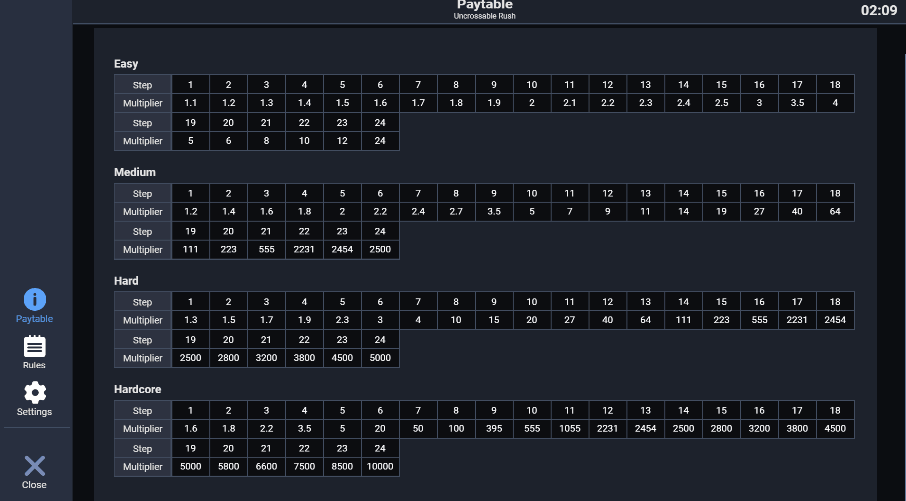
Difficulty mode selection is the single most important strategic decision in Uncrossable Rush. Here is what each mode means in practice:
Easy: Traffic moves slowly. You have time to react to each lane. The maximum multiplier is 24× — modest but achievable. Easy mode is best for new players learning the cash-out mechanic, players with small bankrolls (€10–€20 session budget), and sessions where you want to play for volume rather than chasing large wins. Variance is low and the game feels forgiving.
Medium: A balanced setting that suits most players. Traffic is moderate and the maximum multiplier reaches approximately 200×. Medium mode is the right choice for players who have completed their Easy mode learning phase and want more reward potential without the extreme swings of Hard. Most strategy guides identify Medium as the optimal mode for consistent, long-session play.
Hard: Fast traffic and high volatility. The maximum multiplier reaches approximately 1,000×. Hard mode requires an experienced player with a large enough bankroll to withstand extended losing streaks — plan for at least 100 rounds minimum budget. At €0.50 per round that means €50 in session budget. The reward potential is substantially higher, but so is the frequency of early collisions.
Hardcore: Extreme traffic, very high volatility, maximum multiplier of 10,000×. Only play Hardcore if you can financially and psychologically accept many consecutive losses in exchange for occasional very large wins. Hardcore is not a suitable daily mode for most players. Use the demo to experience the variance before touching real money in this mode.
| Mode | Traffic | Volatility | Max Multiplier | Recommended Bankroll | Best For |
|---|---|---|---|---|---|
| Easy | Slow | Low | 24× | €10–€20 (100 rounds) | New players, small bankroll |
| Medium | Moderate | Medium | ~200× | €20–€40 (100 rounds) | Balanced sessions, most players |
| Hard | Fast | High | ~1,000× | €50–€100 (100+ rounds) | Experienced players |
| Hardcore | Extreme | Very High | 10,000× | €100+ (150+ rounds) | High-risk specialists only |
Cash-Out Strategy – When to Stop Advancing
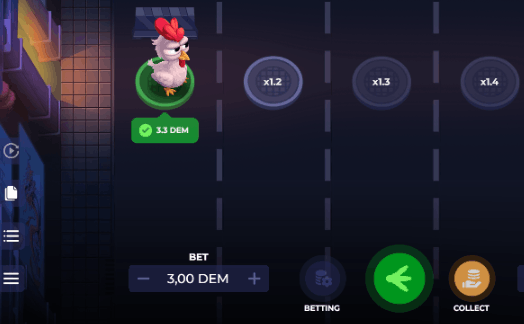
The cash-out decision is the most important action in every round of Uncrossable Rush. The most common mistake players make is not having a target before the round begins — leading to emotional decisions mid-lane that often result in holding too long.
Rule number one: set your cash-out lane target before the round starts. Then stick to it.
Conservative approach — cash out at lanes 3–5: Taking small, consistent wins. This approach prioritises survival over big multipliers. It works well in Easy and Medium mode where the lower multipliers still generate a profit when hit consistently. Cash-out at lanes 3–5 means you are cashing out at multipliers below 10× but doing so very frequently. Over a 100-round session, a high hit-rate at modest multipliers can be profitable.
Moderate approach — target lanes 8–12: A balance between risk and reward. You accept more collisions than the conservative approach but the multipliers you collect when you reach your target are meaningfully higher. This is the most commonly recommended approach for Medium mode players. Set your target at lane 8, 10 or 12 — pick one number before each session and do not deviate.
Aggressive approach — push to lane 15–20+: High variance, high reward. In Hard mode, reaching lane 18–20 can produce multipliers of 200×–500× and beyond. The collision probability is high at these deep lanes, so you will fail to reach your target often. A large bankroll (150+ rounds) is essential. This approach is only sustainable if you can tolerate many rounds of zero return punctuated by occasional large wins.
Key rule: Set a target before the round starts and stick to it regardless of what happens in the lane. If you reach lane 10 safely and start thinking "maybe I'll try for lane 12" — that is how consistent cash-out discipline breaks down. The target set before the round is the only target that counts.
Bankroll Management
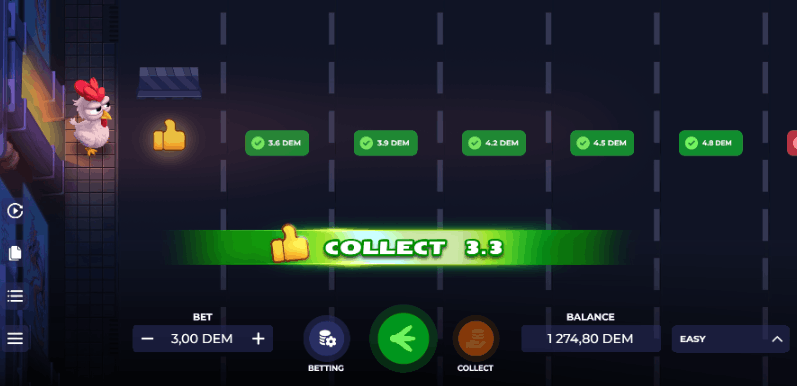
Proper bankroll management is especially important in Uncrossable Rush because of the game's step-based crash structure. A single bad lane can end a round instantly. Here are the core rules:
- Minimum 80–100 rounds per session budget. Your session budget should always fund at least 80 full rounds at your chosen bet size. This gives you enough sample size to experience both losing and winning phases of the variance distribution.
- Never bet more than 1–2% of your session budget per round. At a €20 session budget, your maximum bet is €0.20–€0.40 per round. Betting more than 2% per round means a short loss streak can eliminate your session budget before you have the chance to recover.
- Stop-loss at 50% of session budget. If you lose 50% of your starting session budget — stop. Come back another day. Chasing losses in a high-variance game accelerates the rate of loss.
- Set a win target. If you reach 2× your starting session budget, consider stopping. Locking in a win is not mandatory, but it prevents the common pattern of turning a profitable session into a losing one by continuing too long.
Example bankroll table:
| Session Budget | Bet Per Round (1%) | Rounds Available | Stop-Loss Trigger | Recommended Mode |
|---|---|---|---|---|
| €10 | €0.10 | 100 | €5 | Easy |
| €20 | €0.20 | 100 | €10 | Easy / Medium |
| €50 | €0.50 | 100 | €25 | Medium / Hard |
| €100 | €1.00 | 100 | €50 | Hard |
| €200 | €1.00–€2.00 | 100–200 | €100 | Hard / Hardcore |
Autoplay and Martingale Settings
Autoplay: Uncrossable Rush offers an autoplay function that lets you set a fixed cash-out lane and run multiple rounds automatically. This is useful for Easy and Medium mode sessions where you want to apply a consistent conservative cash-out without the fatigue of manual decision-making for every round. Set your lane target, activate autoplay, and let the session run while you monitor the balance.
Autoplay is less advisable in Hard and Hardcore mode because those modes benefit from active session monitoring — knowing when you've hit your stop-loss or win target requires attention.
Martingale system: Martingale doubles your bet after each loss in the expectation of recovering all previous losses with one win. The appeal is clear: one successful round covers everything. The problem in Uncrossable Rush is that Hard and Hardcore mode produce extended loss streaks. A Martingale sequence of 10 consecutive losses starting at €0.20 reaches a bet size of €204.80 on the 11th round — far exceeding any sensible bankroll limit.
Recommendation: If you wish to use Martingale, only apply it in Easy mode with a strict stop-loss. Set a maximum number of Martingale steps (for example: stop doubling after 5 consecutive losses regardless of the sequence). This caps your maximum exposure at a predictable level. Do not use Martingale in Medium, Hard or Hardcore modes. The loss streaks in those modes are too long for Martingale to be sustainable.
What Strategies Don't Work
Understanding what does not work is as important as knowing what does. Avoid these common but ineffective approaches:
Pattern recognition: The RNG generates each round independently. There are no patterns in the traffic behaviour, no streaks, no "due" lanes. Watching previous rounds looking for patterns is wasted effort — those outcomes have zero predictive value for the next round.
Hot and cold streaks: There is no such thing as a "hot" or "cold" round in a certified RNG game. A loss on one round does not make a win more likely on the next. A win does not make a subsequent loss more likely. Each round is a fresh, independent event.
"Due for a win" thinking (Gambler's Fallacy): After ten consecutive losses, many players believe a win is overdue. This is the Gambler's Fallacy — a cognitive bias, not a statistical reality. The probability of reaching lane X in Hardcore mode is the same on round 11 as it was on round 1. Previous results have no bearing on future outcomes.
Bet-doubling after wins: The reverse Martingale (doubling after wins, halving after losses) is appealing in theory but suffers the same problem: the RNG does not produce streaks, so a win after a win carries no higher probability than a win after a loss.
FAQs – Uncrossable Rush Strategies
Is there a guaranteed winning strategy for Uncrossable Rush?
No. Uncrossable Rush uses a certified RNG meaning every round is independent and random. No strategy can guarantee a profit. What smart play can do is help you manage your bankroll, choose an appropriate difficulty mode and establish consistent cash-out discipline — all of which improve your overall session experience without eliminating the house edge.
What is the best cash-out point in Uncrossable Rush?
There is no universally optimal cash-out lane. Conservative players do well cashing out at lanes 3–5. Moderate players target lanes 8–12 for a balance of risk and reward. Aggressive players push to lane 15+ for higher multipliers. The most important rule: set your target before the round starts and stick to it no matter what.
Should I use the Martingale system in Uncrossable Rush?
Only with extreme caution and exclusively in Easy mode with a strict stop-loss. Martingale doubles your bet after each loss, which can deplete a bankroll very quickly in Hard or Hardcore mode where loss streaks are long. In Easy mode with a fixed stop-loss of 50% of session budget, it carries manageable risk. In any other mode, Martingale is inadvisable.
Which difficulty mode has the best strategy potential?
Medium mode offers the best balance for strategic play. It has meaningful multiplier potential (~200×) without the extreme variance of Hard or Hardcore. A consistent cash-out target of lanes 8–12 in Medium mode gives you a workable risk-reward ratio that can be sustained over a full session.
How much bankroll do I need for Uncrossable Rush Hard mode?
Plan for at least 100–150 rounds at your chosen bet size. At €0.50 per round that means €50–€75 minimum session budget. Hard mode loss streaks of 20–40 consecutive rounds are not unusual. Without sufficient bankroll depth you are likely to bust before reaching the multipliers that make the mode worthwhile.